


How Video Walls Are Enhancing the Retail Experience
If you’ve ever stopped on the street to watch the huge screens in the window of your local Sports Direct, then you’ve already seen large-format graphics in action. These massive displays—often stretching from floor to ceiling and beyond—are hard to ignore. Bright lights and fast-moving visuals create a powerful backdrop that instantly elevates the shopping experience.
Growing in popularity worldwide, video wall technology has become an increasingly engaging and valuable tool for retail as it continues to evolve. In fact, Grand View Research predicts that the global in-store digital signage market will reach £23.3 billion (US$31.7 billion) by 2028.
It’s no secret that brick-and-mortar retail has faced significant challenges in recent years, impacted by the Covid-19 pandemic and the global boom in e-commerce. While technology has greatly enhanced online shopping experiences, video walls are proving to be just as effective in transforming the physical store environment.
According to Rim Posthumus, Global Account Director at digital signage company Mood Media, video walls allow brands to “showcase innovation, products, and brand values."
He defines the technology as “multiple screens with ultra-narrow bezels that can be combined to create one large display.” These systems are capable of displaying content horizontally, vertically, or even diagonally, and are typically connected to a media player that stores content locally to ensure seamless playback.
A study by ScreenCloud reveals that 80% of customers admit to entering a store because digital signage caught their attention. In addition, 40% of shoppers say digital displays can influence what they purchase, thanks to information shown near the point of sale.
As retailers increasingly aim to create standout experiences beyond traditional purchasing, experiential retail has become a key differentiator.
“Experiential retail and physical experiences are how brands can stand out from competitors, draw people into stores, and create a more immersive experience once inside,” says Posthumus.
The Future of Video Walls in Retail
Several exciting technological developments are currently shaping the video wall landscape. Posthumus highlights emerging trends such as sensor-triggered content, which uses motion sensors to detect when a customer approaches a specific area, automatically activating targeted content on the video wall.
Another growing feature is on-demand content, where a touchscreen tablet allows customers or sales associates to control what is displayed on the video wall in real time.
With virtually limitless applications and constantly evolving technology, video walls have become a highly effective solution for retail brands looking to gain a competitive edge. Below are three standout examples.
Dior
In 2016, Christian Dior opened a new flagship store in San Francisco featuring an elaborate, two-level video wall created by artist Oyoram. The installation is split by a staircase and surrounded by large mirrored walls, which enhance and amplify the visuals.
The striking video wall not only creates a powerful first impression but also aligns perfectly with Dior’s brand identity. Rather than promoting a specific product, it delivers a unique and memorable shopping experience—an important factor for millennials.
As Jeff Fromm, President of FutureCast, explains, millennials are “the generation that equates value with memories and experiences; brands can no longer simply sell products to them, but must create experiences with them.”
As a high-end fashion brand, Dior is synonymous with exclusivity and luxury—both of which are reinforced through digital art and immersive visual storytelling.
Sephora
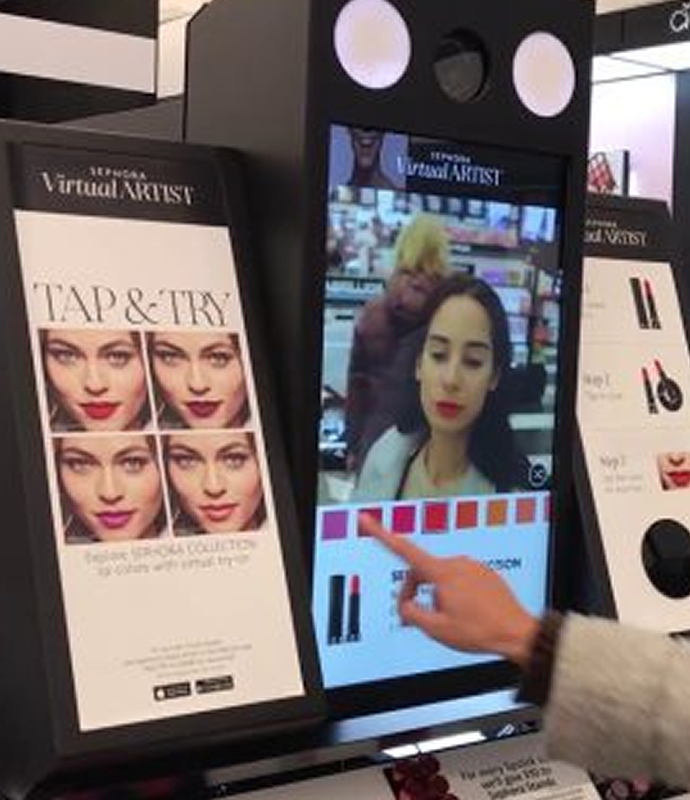
In an innovative move, cosmetics retailer Sephora partnered with AR technology provider ModiFace, implementing digital displays that allow customers to try on makeup virtually.
The technology simulates makeup products on a customer’s face in real time, accurately tracking facial features. Shoppers can instantly test different shades of eyeshadow with a simple tap on the screen.
This solution streamlines the selection process, reducing the need for sales assistance and allowing customers to experiment with multiple products before making a purchase—ultimately lowering return rates.
“Digital and innovation have always been part of Sephora’s DNA,” said Mary Beth Laughton, Executive Vice President of Retail at Sephora.
“Estamos muito focados em nossos clientes e sabemos que a vida dela depende cada vez mais do digital. Então, sabemos que para ter sucesso como varejista, precisamos estar onde nossos clientes estão e fornecer a ela ferramentas e experiências que atendam às suas necessidades.”
British Airways
British Airways’ iconic #Lookup campaign is a powerful example of how digital signage can captivate consumers. The interactive display features a child pointing to the sky as an airplane flies overhead. As the plane approaches, the screen instantly displays the destination and flight number in real time.
Through this digital installation, British Airways created a simple yet highly engaging interactive experience.
“This is a first—not only for British Airways, but for UK advertising,” said Abigail Comber, Head of Marketing at British Airways.
“We all know from conversations with friends and family that we often wonder where planes are going and dream about incredible holidays or cozy destinations.
Smart technology allows this advertisement to engage people in the moment and answer that question for them. We hope it creates a real ‘wow’ factor and reminds people how amazing flying is—and how accessible the world can be.”
clients
Global projects, enabling broad and efficient management and control of operations.















Get Our Services
Software with a highly intuitive interface, providing the best tools for information sharing.